Most AI conversations inside digital experience platforms still revolve around content generation. Generate a landing page. Rewrite a headline. Summarize a document. While those capabilities are useful, they are not the most interesting architectural shift happening inside platforms like Sitecore.
The more important shift is orchestration.
As AI becomes more deeply integrated into search, personalization, content operations, and customer data systems, the platform itself starts behaving less like a traditional CMS and more like an adaptive decision layer coordinating multiple systems in real time. Sitecore’s broader AI direction through Sitecore Stream and SitecoreAI capabilities points clearly in this direction. Instead of treating AI as a standalone assistant, the platform increasingly positions AI as a coordinated layer operating across search, content, customer context, and workflow systems.
This becomes especially relevant in industrial manufacturing and distribution environments where product discovery is rarely a simple keyword search problem.
A buyer searching for:
…is not simply looking for a product catalog entry. They are expressing replacement intent, compatibility constraints, environmental assumptions, manufacturer affinity, and likely operational context. Traditional ecommerce search systems were never designed to reason across those dimensions simultaneously. They were designed to retrieve indexed products. That distinction matters.
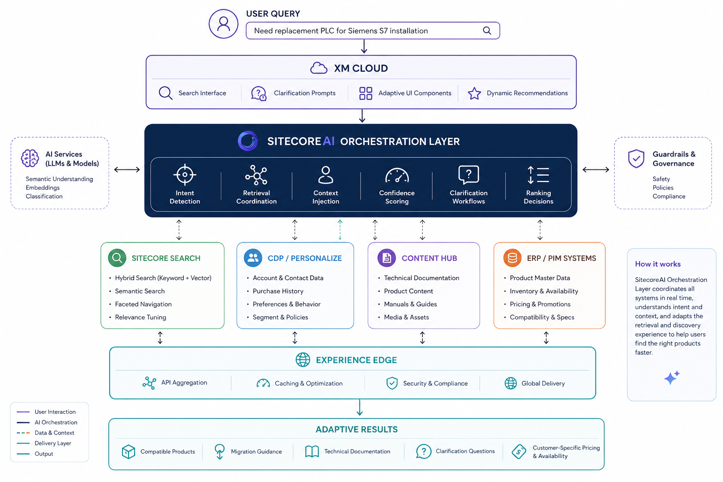
The Architecture Behind Agentic Discovery
In a traditional composable ecommerce architecture, systems usually operate independently. The search engine retrieves products. Personalization engines adjust recommendations after retrieval. The CMS manages presentation. The CDP stores customer context. Middleware coordinates workflows. Most orchestration logic ultimately lives inside custom integrations and hardcoded business rules.
Agentic architectures shift this model entirely.
Instead of static workflows, the platform dynamically coordinates retrieval, customer context, ranking, technical documentation, and clarification flows based on intent. The interesting shift is not AI-generated product descriptions. The interesting shift is adaptive orchestration across previously disconnected systems.
This is where SitecoreAI becomes compelling. Sitecore Search already supports AI-driven search experiences, semantic search capabilities, and behavioral relevance tuning. Sitecore CDP and Personalize already provide customer context and decisioning capabilities. XM Cloud and Experience Edge already support composable experience delivery. The architectural shift happens when these systems begin operating together as a coordinated retrieval and decision framework instead of isolated platform services.
Consider a manufacturer or distributor selling industrial automation equipment including PLCs, VFDs, industrial networking equipment, HMIs, and motors.
A customer searches:
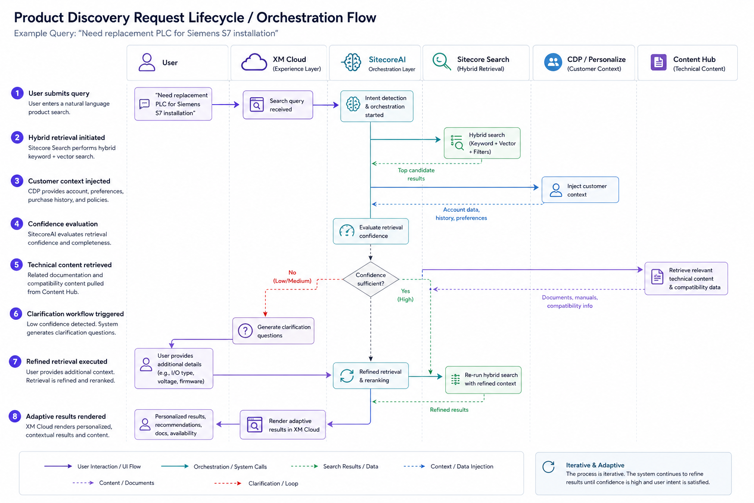
A traditional ecommerce search engine might perform keyword matching, boost Siemens-related products, and return a product grid. An agentic discovery workflow behaves very differently. The orchestration layer identifies replacement intent, recognizes an existing Siemens ecosystem, evaluates probable compatibility requirements, and detects uncertainty around I/O configuration and firmware dependencies. Retrieval immediately becomes contextual instead of static. The system can then prioritize compatible PLC families, surface migration documentation, inject account purchasing history, retrieve technical manuals from Content Hub, and dynamically generate clarification prompts if retrieval confidence falls below acceptable thresholds.
At that point, the platform is no longer acting like traditional ecommerce search.
It is behaving more like an adaptive technical sales assistant.
Retrieval Quality Starts with Product Data
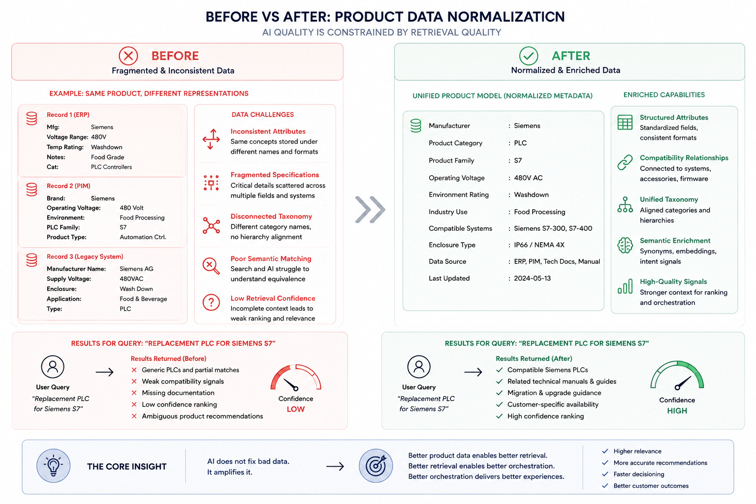
One of the largest implementation mistakes organizations make is introducing AI-assisted retrieval before addressing product data quality. Poor product data creates poor orchestration outcomes. In industrial automation catalogs, the same concept is often represented inconsistently across systems:
- “Input Voltage”
- “Operating Voltage”
- “Voltage Range”
- “Supply Voltage”
Compatibility relationships are frequently buried inside PDFs, specification sheets, or free-text documentation. Traditional keyword search already struggles with this inconsistency. Semantic retrieval systems amplify the problem because embeddings inherit the ambiguity present in the underlying data. Before implementing agentic discovery, product data should be aggressively normalized. Structured technical attributes, standardized units of measure, compatibility mappings, taxonomy alignment, and specification extraction become foundational requirements instead of optimization work.
In practice, the success of AI-assisted discovery is often determined more by metadata quality than by model sophistication. This is one of the reasons many early AI commerce experiences feel inconsistent. The orchestration layer is only as reliable as the retrieval layer feeding it context. Sitecore’s documentation around AI search and content orchestration repeatedly emphasizes the importance of structured content and metadata enrichment because semantic systems depend heavily on retrieval quality.
Why Hybrid Retrieval Matters in B2B Manufacturing
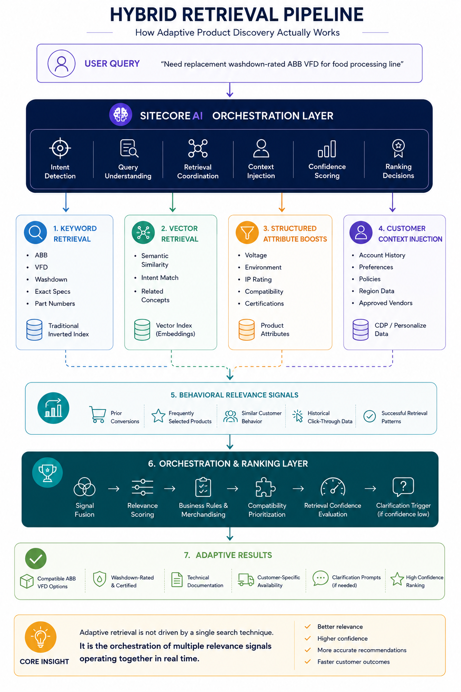
There is also a growing tendency across the industry to treat vector search as a replacement for traditional retrieval models. In B2B manufacturing environments, this usually produces inconsistent results. Industrial product discovery still depends heavily on exact specifications, manufacturer part numbers, voltage ratings, firmware references, compatibility identifiers, and environmental certifications. A search for:
…cannot rely entirely on semantic similarity. Exact-match retrieval still matters.
A more effective architecture combines traditional keyword relevance, vector similarity, structured attribute weighting, behavioral signals, and account-level merchandising logic into a coordinated retrieval strategy. Sitecore Search’s AI capabilities already support portions of this hybrid retrieval approach through semantic search, behavioral ranking, and personalization models.
In practice, the orchestration layer becomes responsible for deciding when semantic interpretation should influence ranking and when exact specification relevance should dominate. That distinction is critical.
Many early AI commerce implementations fail because they over-index toward conversational interpretation while underestimating the importance of deterministic technical retrieval.
Customer Context Should Influence Retrieval
Traditional personalization systems usually operate downstream from search. The search engine retrieves products first. Personalization layers adjust recommendations afterward.
Agentic discovery changes this sequence entirely. Customer context starts influencing retrieval itself. If a customer historically purchases Siemens equipment, operates food processing environments, requires washdown-rated hardware, or maintains approved manufacturer lists, the retrieval strategy should adapt before results are even rendered.
Two customers searching for:
…may require completely different retrieval strategies depending on installed systems, procurement policies, inventory visibility, or operational environments. This is where Sitecore CDP and Personalize become significantly more valuable when coordinated through orchestration layers instead of static rule trees. The retrieval system begins behaving less like a catalog index and more like a contextual technical advisor.
Adaptive Clarification Changes the Discovery Experience
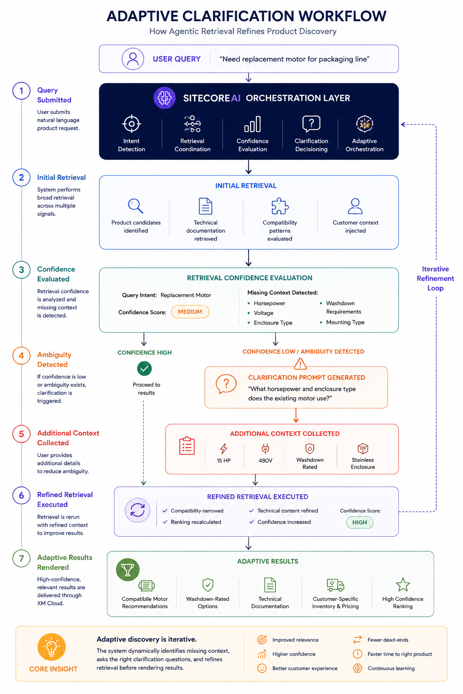
One of the more compelling orchestration patterns emerging in SitecoreAI-style architectures is adaptive clarification. Many industrial product searches are incomplete by nature.
A search for:
…contains major ambiguity around horsepower, enclosure type, mounting configuration, environmental exposure, voltage, and duty cycle requirements. Instead of simply returning a massive product grid, the orchestration layer can evaluate retrieval confidence, identify missing constraints, generate targeted clarification prompts, and refine retrieval dynamically before final rendering. This creates a dramatically different discovery experience than traditional faceted navigation. The platform starts behaving more like an adaptive engineering workflow than a static ecommerce experience.
Observability Becomes Critical
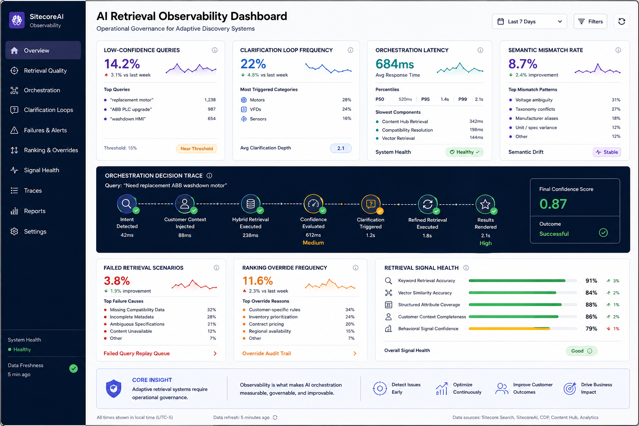
One of the least discussed aspects of AI-assisted discovery systems is observability. Traditional search platforms already require telemetry around zero-result searches, abandoned sessions, reformulations, and engagement metrics. Agentic systems require significantly deeper visibility into orchestration behavior itself. Organizations should monitor:
- retrieval confidence
- orchestration decisions
- clarification frequency
- ranking overrides
- fallback paths
- hallucination boundaries
- retrieval latency
- tool invocation chains
Without observability, orchestration layers quickly become difficult to govern and optimize. This becomes especially important in industrial commerce environments where retrieval accuracy directly impacts quoting, procurement workflows, and operational continuity. The organizations that succeed with SitecoreAI will likely treat orchestration telemetry as seriously as application telemetry.
The Bigger Shift
The most important thing happening inside platforms like Sitecore is not AI-generated content. It is the convergence of retrieval, personalization, customer context, structured content, orchestration, and adaptive decisioning into coordinated workflows capable of operating in real time. Historically, these systems operated independently. Agentic architectures start collapsing these boundaries into unified operational intelligence layers. That is a fundamentally different architectural model than traditional ecommerce. And ultimately, the organizations that benefit most from SitecoreAI will probably not be the ones with the most AI features. They will be the organizations with the cleanest operational data, the strongest retrieval quality, the clearest orchestration boundaries, and the best visibility into how adaptive decisions are being made.
Because adaptive commerce systems are not built on prompts alone.
They are built on structured operational intelligence.