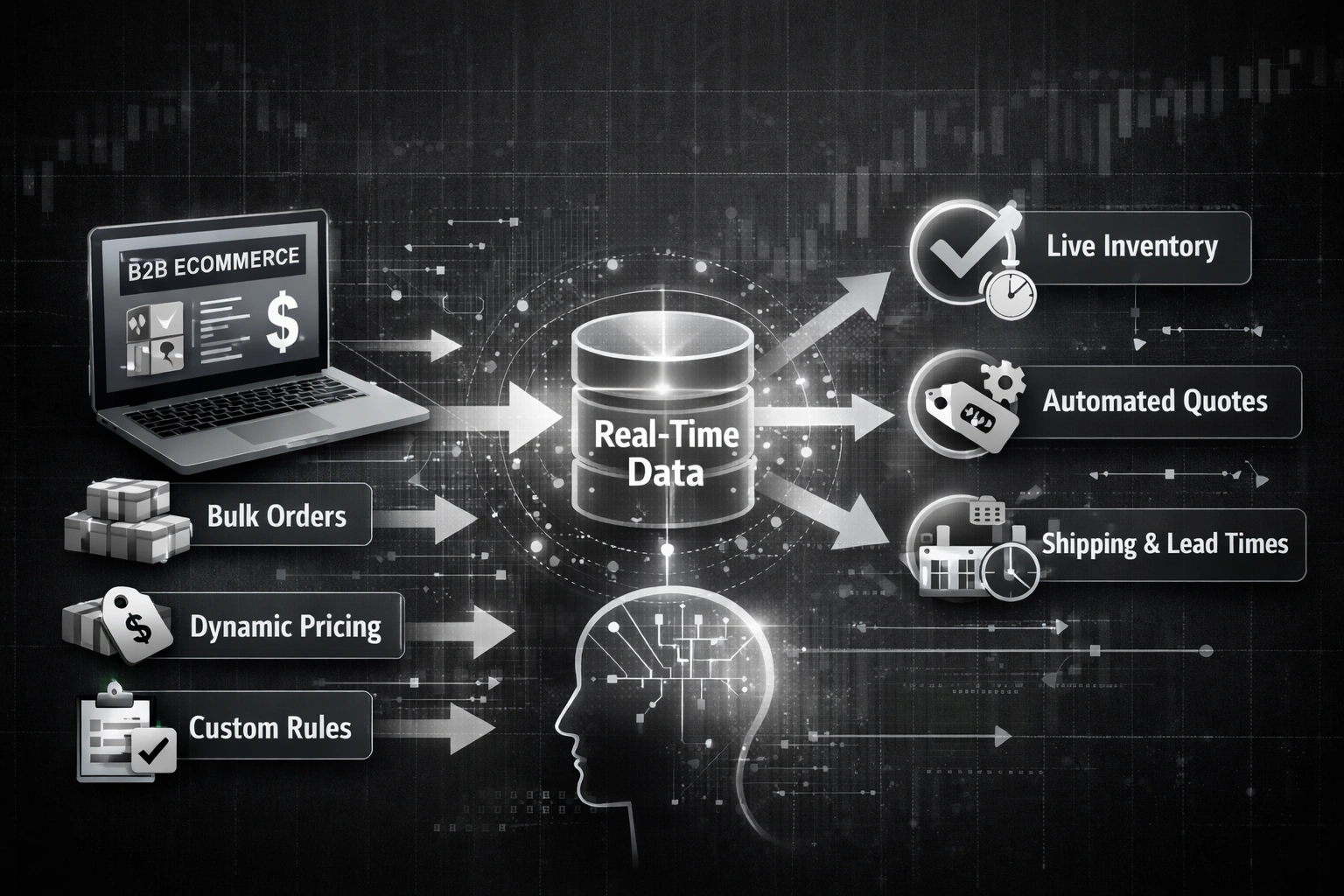
Today, a growing share of B2B buying is being executed by systems, not humans. Procurement platforms, punchout catalogs, EDI pipelines, and customer apps need clear, machine-readable answers in real time. If your ecommerce environment cannot expose those answers consistently, you do not just get a clunky website. You get order exceptions, delayed shipments, invoice disputes, and rising cost-to-serve.
The three answers that matter most are also the easiest to underestimate. What is the price for this buyer in this context? Can you fulfill it in the timeframe implied by the buying experience? Is the order valid given packaging rules, compliance requirements, and customer eligibility?
Pricing is a function, not a field
In manufacturing and distribution, price depends on contract terms, unit-of-measure rules, quantity breaks, ship-to specifics, effective dates, and sometimes channel or program constraints. If each channel computes that differently, buyers will see mismatches between web, quotes, and invoices. Programmatic pricing needs to be governed, traceable, and stable for a given context.
Availability is a promise, not an inventory number
Many teams accidentally publish “on-hand” as if it were “available-to-promise.” That works until allocations, lead times, cut-off times, and network sourcing rules come into play. Buyers plan around your signals. When the signal is wrong or stale, trust erodes quickly. Exposing availability programmatically forces you to define what your availability means, and to keep it consistent across channels.
Constraints are where self-service succeeds or fails
Constraints are the quiet driver of exceptions. Minimum order quantities, order multiples, pack rules, restricted products, hazmat limitations, and geo restrictions can all make an order invalid. If constraints are only documented in PDFs or known by customer service, ecommerce accepts orders that operations later rejects. Programmatic constraint exposure prevents that by making “can I buy this?” computable.
The practical idea: an Orderability Contract
A useful way to bring this together is to define an “Orderability Contract” for your most important SKUs and customers. It is a machine-readable promise that states how price, availability, and constraints will be returned for a given context, and how you can prove what was communicated at order time.
At minimum, an Orderability Contract should define:
- Pricing rules and required context (customer, ship-to, UOM, breaks, effective dates)
- Availability semantics (ATP vs on-hand vs lead-time, plus cut-off and sourcing assumptions)
- Constraint enforcement (MOQ/multiples, eligibility, compliance, geo and shipping limitations)
Why this becomes a competitive advantage
When pricing, availability, and constraints are exposed programmatically in a consistent way, self-service becomes reliable. Reliable self-service reduces exceptions, accelerates partner onboarding, and increases buyer confidence. Over time, that shows up as higher repeat order volume and lower cost-to-serve.