Shopify has firmly entered the B2B conversation. It is fast, flexible, and capable of delivering a modern buying experience that most legacy platforms cannot match. For distributors and manufacturers coming off older systems, it often feels like a clear upgrade. Launch timelines shrink. User experience improves. Teams finally feel like they are moving forward.
But once real customers begin to interact with the system, a different reality sets in.
The issue is not that Shopify is lacking capability. The issue is that most B2B organizations are attempting to run a full business on top of a platform that was designed to optimize transactions, not govern business operations. Shopify performs exceptionally well as a commerce layer. B2B requires something more complete. It requires a coordinated system.
Shopify Solves the Experience. B2B Still Needs the System.
At its core, Shopify excels at the parts of commerce that are visible:
- Fast, intuitive storefronts
- Reliable checkout
- Clean developer experience
- Rapid iteration
These are meaningful advantages. They matter.
But B2B commerce is not defined by the storefront. It is defined by the rules behind it. Pricing structures, account hierarchies, operational workflows, and system integrations all shape how the business actually functions. Shopify can participate in these areas, but it does not inherently control them.
That distinction is subtle at first. Over time, it becomes the central challenge.
Where the Gaps Start to Show
The first signs of strain usually appear in pricing. In B2B, pricing is rarely simple or centralized. It lives across ERP systems, negotiated contracts, and sales-driven adjustments. Shopify introduces mechanisms like catalogs and company profiles, but the real logic often remains external. This creates a situation where pricing is displayed in one place but governed in another, and maintaining alignment becomes an ongoing effort.
Integration quickly follows as the next pressure point. What begins as a straightforward implementation evolves into a multi-system architecture involving ERP, PIM, middleware, and analytics platforms. The challenge is no longer about connecting systems. It is about defining responsibility. When inventory conflicts arise or orders fail mid-process, the absence of clear ownership leads to operational friction.
Workflows add another layer of complexity. B2B buying behavior does not map neatly to standard ecommerce patterns. Purchase orders, approval chains, bulk ordering, and repeat purchasing all introduce requirements that extend beyond a typical add-to-cart experience. Shopify can be extended to support these scenarios, but often through a combination of apps and custom logic that increases long-term complexity.
At the same time, product data becomes a limiting factor. B2B buyers expect precision. They rely on structured attributes, technical specifications, and compatibility data to make decisions. Without a strong data foundation, even the best-designed storefront struggles to perform. Search results become inconsistent, filters break down, and users are forced to rely on sales teams for information that should be available digitally.
Search is where all of this converges. When a buyer cannot find what they are looking for quickly, the experience fails, regardless of how well the site is designed. Out of the box, Shopify search is not optimized for attribute-heavy catalogs or exact-match expectations. Improving it requires ongoing effort and intentional design.
The Pattern Behind the Problems
These challenges are often treated as separate issues. Pricing needs refinement. Integration needs improvement. Search needs tuning.
In reality, they all stem from the same root cause.
There is no shared system design.
Most teams implement Shopify as if it were the center of the architecture. In practice, it is one component within a broader system that includes:
- ERP as the operational source of truth
- PIM as the product data foundation
- Middleware as the orchestration layer
- Search as the discovery engine
- Analytics as the feedback loop
Without a clear model for how these pieces interact, inconsistencies emerge. Data diverges. Workflows fragment. The system becomes harder to manage over time.
What High-Performing B2B Shopify Systems Do Differently
The path forward is not about replacing Shopify or adding more tools. It is about introducing coherence.
High-performing teams start by defining where truth lives. Pricing, inventory, and product data must have clear ownership. When multiple systems attempt to control the same domain, inconsistencies are inevitable. Establishing a clear source of truth, supported by defined expectations for how and when data moves, creates stability across the system.
They also treat integration as orchestration rather than connectivity. Instead of simply moving data between systems, they design workflows that enforce business rules and handle exceptions. Middleware becomes an active component of the system, responsible for ensuring that processes complete reliably rather than passively transferring information.
Product data is elevated to a strategic priority. Attributes are standardized, enriched, and continuously improved. This investment pays dividends across the entire experience, from search and navigation to recommendations and automation. Strong product data is not just a content problem. It is a performance driver.
Search is approached as an ongoing discipline tied directly to revenue. Teams actively monitor query performance, tune relevance, and test improvements. They understand that even small gains in search accuracy can produce meaningful increases in conversion and average order value.
Finally, successful organizations embrace the hybrid nature of B2B commerce. They design systems that support both self-service and sales-assisted interactions. Sales teams are given visibility into customer behavior, and customers are given the flexibility to move between digital and human-assisted experiences without friction.
What This Looks Like in Practice
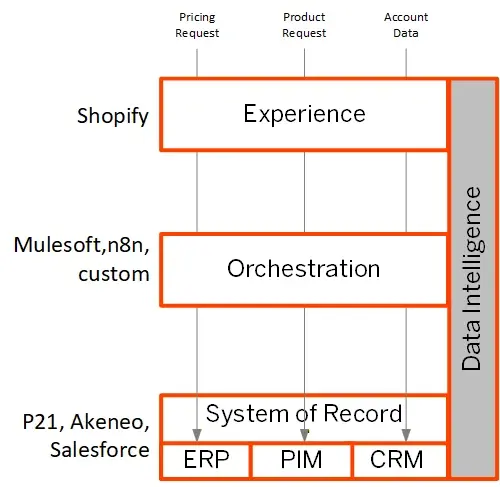
When these principles are applied, the architecture begins to take on a different shape.
Instead of a platform-centric model, you get a system-centric model:
- Shopify handles experience and checkout
- ERP governs operational truth
- PIM structures and enriches product data
- Middleware orchestrates workflows and logic
- Search drives discovery and precision
- Analytics connects behavior to outcomes
Each component has a defined role. Each interaction is intentional.
Why This Matters Now
B2B expectations are changing quickly. Buyers are bringing consumer-grade expectations into professional purchasing environments. They expect speed, accuracy, and autonomy. At the same time, internal teams are under pressure to operate more efficiently and make better use of data.
Shopify enables the experience side of this shift. It does not, on its own, solve the operational side.
That gap is where most implementations struggle.
Closing Perspective: Coherence Is the Real Advantage
The biggest gap in B2B Shopify is not a missing feature or a specific limitation. It is the absence of a cohesive system that aligns data, workflows, and responsibilities.
The companies that close this gap do not necessarily have more technology. They have better alignment. Their systems agree with each other. Their data is consistent. Their workflows are intentional.
In B2B commerce, that alignment shows up quickly. It improves conversion, reduces operational friction, and creates a foundation that can scale.
Shopify is a strong starting point. But the advantage does not come from the platform alone.
It comes from how well the system around it is designed.