In complex B2B environments, product information is often fragmented across ERP, PIM, eCommerce, spreadsheets, supplier feeds, and EDI mappings, leading to inconsistent specs, outdated pricing, incomplete attributes, and conflicting inventory data. These gaps create quoting errors, fulfillment mistakes, compliance risk, poor search performance, lost conversions, and costly returns all leading to revenue and margin erosion. Without clear ownership, measurable standards, and disciplined synchronization, product data quietly erodes operational efficiency and customer trust.
This concept extends upstream by recognizing that product data rarely originates with the distributor or manufacturer, instead it flows from raw material suppliers, component vendors, contract manufacturers, regulatory bodies, and logistics partners. If upstream specifications, certifications, compliance documents, lead times, country-of-origin data, or material disclosures are inaccurate or late, every downstream system inherits the error. By applying measurable standards to incoming supplier data, validating it at ingestion, enforcing required attributes, version-controlling changes, and tracking provenance organizations can prevent defects from propagating through ERP, PIM, eCommerce, EDI, and customer-facing channels. In this way, data integrity becomes a supply chain discipline, not just a commerce function, reducing compliance risk, freight misclassification, production delays, and customer-facing inaccuracies before they ever reach the market.
A Product Truth SLA (Service Level Agreement) is a formal commitment that an organization’s product data will be accurate, complete, consistent, and timely across all systems and channels. Rather than focusing on system uptime or infrastructure performance, it defines measurable standards for the integrity of product information, ensuring that specifications, pricing, inventory, certifications, and digital assets remain synchronized between ERP, PIM, eCommerce, EDI, and marketplace platforms. In complex B2B environments, a Product Truth SLA elevates product data from a content task to mission-critical operational infrastructure.
To fully explain and begin attacking this idea (and problem), it can be broken into two parts. 1) Understanding the flow of data and 2) Establishing a Service Level Agreement.
Understanding the flow of data
Before standards can be enforced, the organization must map how product information moves, where it originates (who owns it), how it is transformed, which systems store it, who modifies it, and where it is ultimately consumed. This includes supplier feeds, engineering systems, ERP, PIM, eCommerce platforms, EDI mappings, marketplace exports, and customer portals. Without a clear data lineage model, errors propagate invisibly, ownership becomes ambiguous, and inconsistencies become systemic rather than accidental.
To accomplish this, use simple visuals and a single attribute. Work backwards from the customer facing surface (think eCommerce site, CPQ system, etc). Draw the storage points along with the lag and processes used in between these points. Using price as an example, your drawing should look something like this:
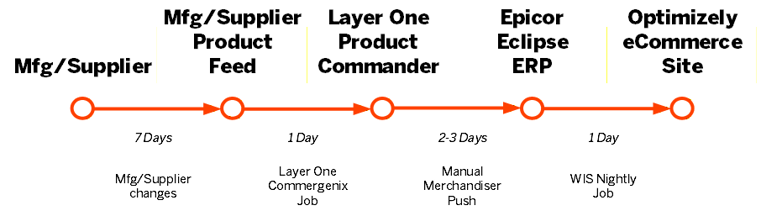
In the above example, we can see that while the manufacturer/supplier updates the price every 7 days, the price takes an additional 4-5 days to make it through to the eCommerce site.
Once you have worked a single attribute through to completion, move on to other critical attributes. We find the most impactful and best places to start are Pricing, Availability, Lead time, and Regional restrictions. From there you may consider the following list:
- Compliance information
- Country of origin
- MSDS & related docs
- Physical attributes
- Substitutes & Alternatives
Establishing a Service Level Agreement
Once the flow is understood, measurable expectations can be defined. This means setting explicit thresholds for accuracy, completeness, synchronization timing, validation rules, and escalation procedures. It assigns ownership, defines acceptable tolerances, and creates accountability across teams and systems. The agreement transforms product data from an informal responsibility into an operational commitment with defined performance standards.
If we continue the pricing example above, we can define our initial Product Truth SLA for pricing as follows:
Objective: Ensure that customer-facing prices are accurate, synchronized, and updated within defined time thresholds across all systems.
- Source of Truth
- ERP is designated as the authoritative source for base price and contract pricing.
- No downstream system (PIM, eCommerce, marketplace feeds) may override ERP pricing without documented exception.
- Upstream cost (driving price) is set by the manufacturer/supplier data feed.
- Update Timeliness
- Cost changes from manufacturer/supplier must propagate to the ERP within 1 day.
- Standard price changes must propagate from ERP to eCommerce within 15 minutes.
- Contract pricing updates must reflect in customer portals within 5 minutes of approval.
- Promotional pricing must activate/deactivate within ±2 minutes of scheduled time.
- Accuracy Threshold
- ≥ 99.8% of SKUs must display prices that match ERP within a $0.01 tolerance.
- 100% of contract accounts must receive their negotiated pricing without fallback to list price.
- Validation & Monitoring
- Automated reconciliation runs every hour comparing ERP vs. eCommerce price tables.
- Any variance beyond tolerance triggers an alert to IT and pricing operations.
- Root cause analysis required for any pricing discrepancy affecting more than 10 SKUs.
- Escalation
- Critical pricing errors (e.g., zero price, 50%+ deviation) must be corrected within 1 hour.
- Major errors (affecting >100 SKUs) require executive notification.
The Infrastructure of Trust
At its core, this approach brings discipline to one of the most fragile yet business-critical assets in any B2B organization: product data. By first mapping how information flows from upstream suppliers through ERP, PIM, eCommerce, EDI, and customer-facing channels and then establishing measurable service level commitments around accuracy, completeness, and timeliness (such as pricing synchronization thresholds), organizations move from reactive data cleanup to proactive governance. The result is fewer operational errors, protected margins, reduced compliance risk, and greater customer trust…because the data driving every transaction is no longer assumed to be correct, but formally managed as operational infrastructure.
If your organization is working to bring greater discipline and visibility to product data, start a conversation with the Layer One team.