Transforming Complex Cable Quoting into a Structured Digital Experience
In B2B environments with highly configurable products, digital performance is rarely limited by traffic or demand. The constraint is almost always translation. Buyers know what they need, but systems struggle to capture that intent in a structured, usable way. For manufacturers like Lake Cable, the challenge is not generating requests. It is turning those requests into something that can be acted on efficiently and consistently.
Lake Cable operates in a category where product complexity creates real friction in digital experiences. A single cable configuration can involve multiple variables including conductor count, shielding, insulation, voltage rating, and application-specific requirements. Buyers rarely arrive with a clean SKU. They arrive with intent that needs to be translated.
Their website functioned as a lead generation and quoting channel, but the underlying experience made that translation difficult.
Search was available, but not aligned with how engineers and buyers describe cable specifications. Product discovery often required prior knowledge or manual navigation. When users could not find what they needed, they defaulted to submitting requests through a basic form.
Those requests were largely unstructured. Free-text RFQs varied widely in quality and completeness, often missing critical attributes. Internal teams were left to interpret intent, ask follow-up questions, and reconstruct requirements before a quote could even begin.
At the same time, product visualization did little to support decision-making. Many configurations lacked clear representation, making it harder for users to validate what they were requesting.
As VP of Electronic Cable Solutions, Somie Mossell described it:
We were getting a lot of inbound requests, but too many of them required follow-up just to understand what the customer actually needed.


The result was a system that captured demand, but did not translate it efficiently or consistently. It relied heavily on human interpretation and did not scale with increasing complexity.
The work focused on restructuring how intent is captured and carried through the system, rather than optimizing isolated features.
Search was refined to better reflect attribute-level relevance, allowing users to get closer to the right product or configuration path without needing perfect inputs. This improved the role of search as an entry point into the experience.
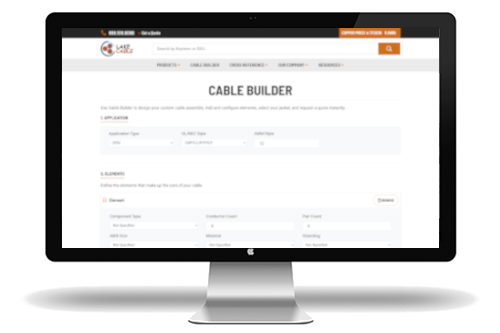
A guided quoting tool, the Cable Builder, replaced the traditional free-text RFQ approach. Users can now define cable requirements through structured inputs while still adding contextual comments where needed. This shifted quote submissions from open-ended descriptions to more complete, attribute-driven requests.
Product visualization was enhanced through agentic image generation, enabling consistent imagery based on product attributes. This gives users a clearer reference point as they define configurations and helps validate their selections.
These changes resulted in a measurable shift in how the system captures and processes intent.
Quote submissions are now more structured and complete, reducing ambiguity at the point of entry. Internal teams receive inputs that are closer to a usable specification rather than a starting point for interpretation.
The quality of inbound requests has improved, with fewer gaps in critical information and less need for initial clarification cycles. This allows quoting and engineering teams to engage more efficiently and with greater confidence.
As Somie Mossell noted:
The difference now is the quality of information we receive. We’re starting much closer to a real specification instead of trying to piece things together from a paragraph.
User behavior has also shifted. Instead of relying primarily on free-text submissions, users are engaging more directly with guided flows and structured inputs, indicating stronger alignment between the experience and how buyers think about these products.
While these changes have not yet translated into a clear, measurable increase in revenue, they represent a meaningful improvement in the system’s ability to capture and translate customer intent.
This has changed how customers interact with us digitally. It’s not just more activity, it’s better input,
added Mossell.
Lake Cable now has a foundation that supports measurement, iteration, and future optimization. With structured data flowing into the quoting process, the business is positioned to analyze performance, refine experiences, and incrementally improve conversion over time.
In complex B2B environments, meaningful business outcomes are the result of consistent, system-level improvements in how customers interact with your business.
What has been established here is a shift from a reactive, interpretation-heavy model to a more structured and scalable digital foundation. Search, quoting, and product representation now work together to capture intent more clearly and consistently.
These types of systematic improvements do not operate in isolation. They compound. Better inputs lead to better quoting. Better quoting leads to faster response times. Faster, more accurate responses lead to stronger customer trust and higher conversion over time.
The outcome is not just a better interface. It is a system designed to produce more consistent results.
And in this category, consistency is what drives growth.